

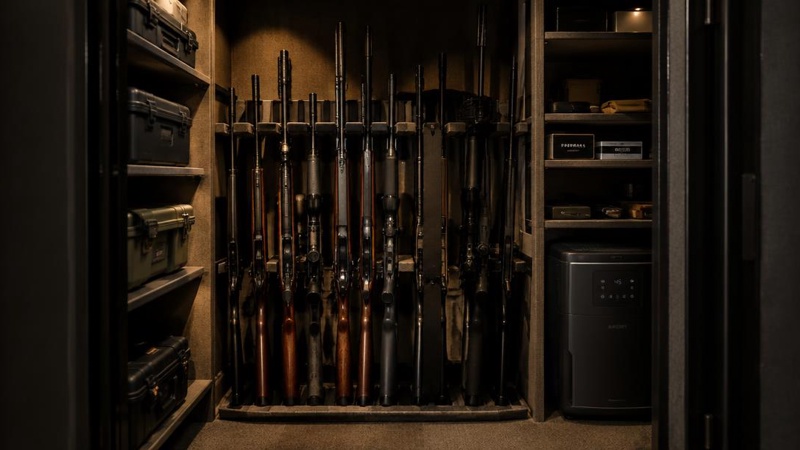
The Safe Storage and Equipment Care guide is aimed to help develop a routine for storing and looking after sports equipment safely and to maintain it in good working order. This should be possible to check, to explain to others and to maintain without too much trouble. It does not necessarily have to involve purchasing special products. In each case it is best to follow local laws as well as range rules and manufacturer’s instructions. Any maintenance or repairs that are required should ideally be done by qualified people.
Start with the real use case
Be a responsible consumer. Your good decisions about keeping sporting equipment secure and serviceable will start with good decisions about purchasing sporting equipment in the first place. Consider where you will be to use your new equipment. What is the likely weather? How long will your trip be? How far will you have to carry your new sporting gear? Will you be carrying it any distance at all? Who is going to be using the new piece of equipment? As a beginner or occasional user, consider purchasing a variety of items that can be used for different purposes.
Inspect before every outing
Check locked storage, check moisture control, check inspection records and check out the rules of the household before you go out. Check in good light for any signs of wear and tear, any loose parts, any signs of contamination, check that all parts have been correctly adjusted. Take notes on any parts that need to be repaired or replaced and try to note these up within five minutes of finding the problem. This is a lot easier than an annual check over.
Make fit part of the safety check
Be mindful of fit to allow for proper comfort. Make sure that items don’t pinch or move about whilst in use. Try them on with the appropriate clothing and test them out in the sort of activities that you will be doing. If items only seem to work when standing still in a warm room then they aren’t suitable for your needs.
Adjust in a controlled order
Adjust one factor at a time. Try to see the effects of any change or adjustment made to a piece of sporting equipment. Keep a note of any alterations made and put the equipment through a short trip or practice session. This will enable you to appreciate whether any improvement was down to the change made and if any new problems have been introduced.
Spend where reliability matters
Rather than allocating your budget for a number of accessories, consider the sporting equipment that you will be using the most, perhaps to protect yourself or learn new ways of playing sport. Invest in good quality items, such as protective sports equipment, sports lessons with a qualified coach and goods that can be easily replaced should they get damaged, such as extra balls etc. Additional sporting equipment can be purchased at a later date after you have gained more experience and have a better understanding of your requirements.
Plan for weather and transport
Other weather factors also need to be taken into account, for example, extreme temperatures can lead to a rise in human fluid levels (hydation) and may increase the risk of penetration of unsealed parts by rain and moisture, and also of dust entering into moving parts. Squeezing extra lubrication into critical areas and trying to dry out equipment that has been left in its closed storage to allow it to fully dry out after a trip is a simple but effective way to maintain sporting equipment in top condition.
Use clear range and field habits
Have someone else check things with you too. That way, you can tell another person what you are checking and the person can tell you if you are not following local rules or ways of doing things. Of course the best person to ask is someone who works at the local club or range, but even other visitors will do in a pinch.
Clean without causing damage
The maintenance of all equipment must adhere strictly to the recommendations of the manufacturer for cleaning, lubricating, etc. There is no such thing as more of a good thing. More oil, more force, etc., are not better. Some materials for cleaning can damage the finishes, seals, adhesives and optical coatings of some pieces of equipment. Also, some parts must not be touched by liquids and some must not be cleaned at all. Therefore, the recommended materials must always be used for maintenance and one must stop as soon as any sign of damage occurs and have the item serviced by a competent technician.
Review the kit after the trip
When the session has ended, review what actually happened and what didn’t work. Write down any unused kit, equipment that was hard to reach for and which of your consumables you would have used in an emergency. Be ruthless – get rid of the redundant weight from your kit and replace any used up consumables.
A simple checklist
- Make sure you are playing the sport for the right reasons and confirm the purpose, conditions and local rules of play before selecting the correct equipment for the occasion.
- Inspect fit, condition and adjustment in a controlled setting.
- Only carry with you the extra protection and support equipment that you actually need for the activity.
- Record maintenance and replace damaged components instead of improvising repairs.
- Clear up, dry off and put away all of your outdoor equipment straight after returning from your trip.
Final perspective
Spare Sporting Equipment is Best Left to Shrunkit – simple and methodical and each aspect developed in turn. In this way all Sport can be optimized and, when played, enjoyed rather than marred by haphazard arrangements left to chance.
Practical note 1
Suffice to look at applying things on a day to day basis. Set up a short practice session, keep the intensity down and list one thing you improved afterwards. Try to be consistent applying these things on a daily basis rather than trying to solve everything in one day.
Practical note 2
Be aware of where you store your sporting equipment. The best container is of little value if it is located in a temperature fluctuating garage, a damp cellar or even a sports corridor. Don’t label your case with what is in it – to potential thieves this can be far too tempting. Keep keys and access codes to locked cases under your own control.
Practical note 3
Most online reviews list out a series of good questions to consider and help to highlight potential issues that may not be immediately apparent. However, nowhere near as much value can be gained from reading reviews than by physically trying out pieces and getting the views and advice of an experienced individual to highlight the good and the not so good points of said item(s).
Practical note 4
A good test is to go for a short practice session. Keep the intensity low and the length of time short in order to test out the new arrangement and write down one positive point of improvement for future reference.